
Which counties in DFW are growing or shrinking?
The Census just released 2025 population estimates. Here’s what they show — and what they don’t.

Collin County grew more last year than Dallas County has in the past five.
The U.S. Census Bureau released its annual population estimates on March 26, 2026, covering every county and metro area in the country through July 2025. The headline nationally: America’s biggest counties are growing slowly. Houston and Dallas-Fort Worth added more people than any other metro in the country.
But zoom in on Texas and a sharper picture emerges. This is not a state that’s growing uniformly. It’s a state splitting in two: a suburban ring that can’t build fast enough, and an urban interior that’s quietly emptying out.
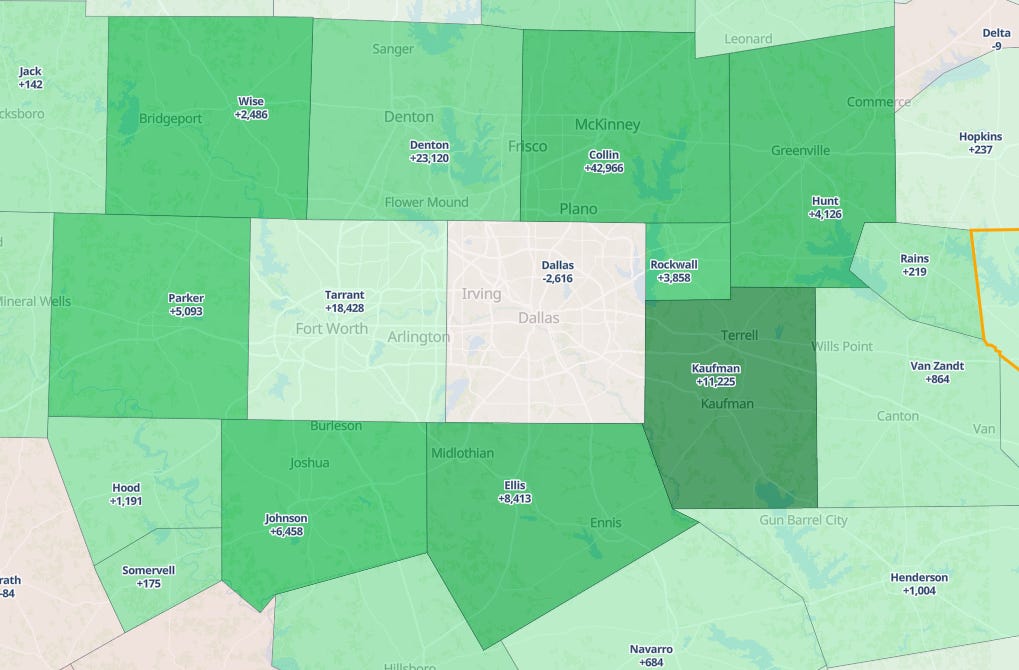
For instance, Dallas County lost 2,616 people last year while Kaufman gained 11,225.
Percentages are misleading, let use raw numbers:
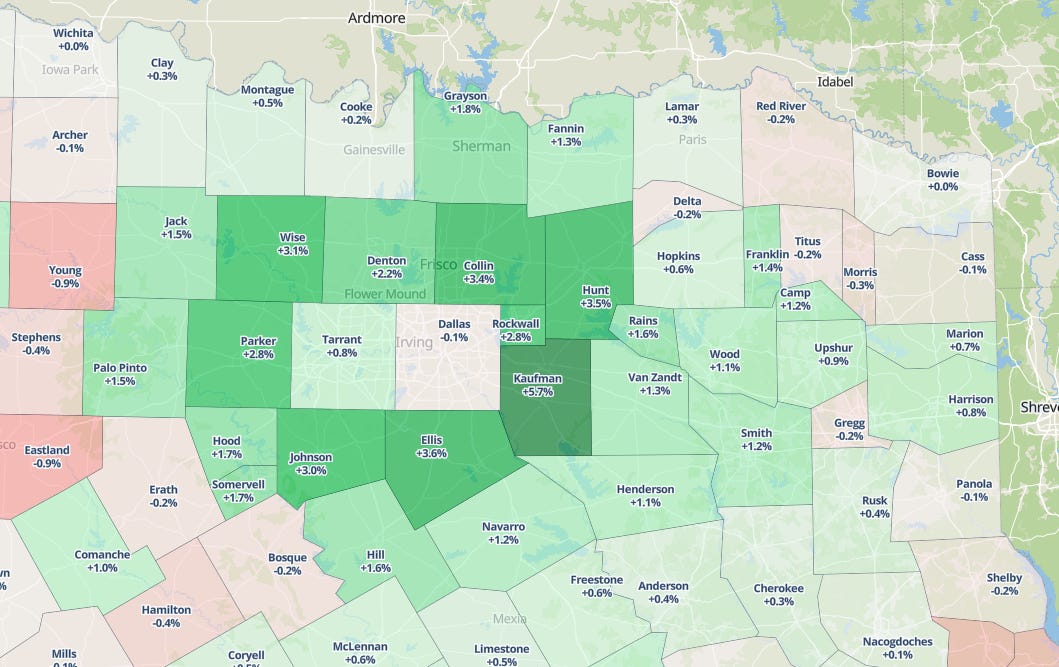
Percentage Growth:
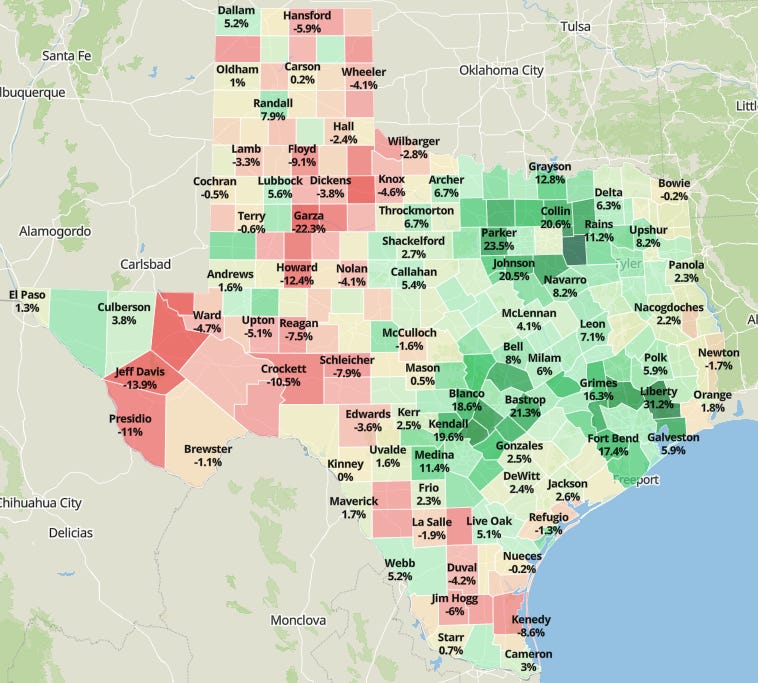
Texas added 2,471,926 people between 2020 and 2025. That’s an 8.5% increase — roughly the population of Houston appearing in five years. But 84 of Texas’s 254 counties — one third — lost population over the same period. The growth is not statewide. It’s concentrated in a handful of suburban counties ringing four metro areas.
Where 2.5 million people went
The top 10 counties by absolute growth tell the story:
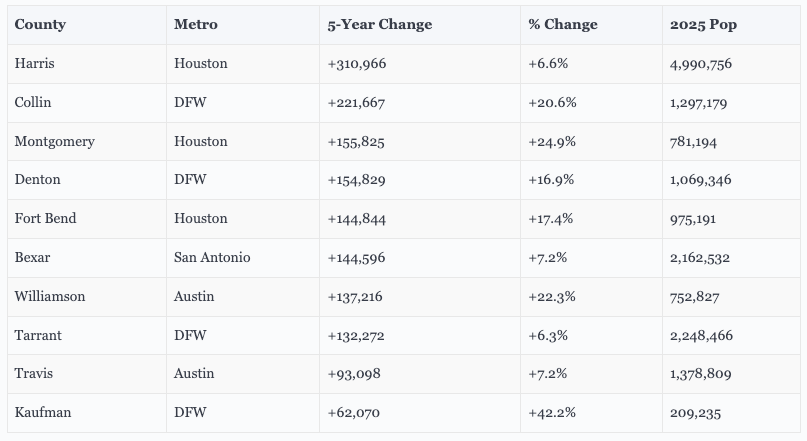
These 10 counties — out of 254 — account for 1.56 million of the state’s 2.47 million new residents. That’s 63% of all Texas growth in just 4% of counties.
Every single one is in one of four metro areas: DFW, Houston, Austin, or San Antonio. No rural county, no mid-sized city, no border town makes the list.
See the full map: Texas Counties — Population Growth 2020-2025
The DFW explosion
See the map: DFW Counties — Population Growth 2020-2025
Dallas-Fort Worth added 810,000 people since 2020, pushing the metro past 8.47 million — the 4th largest in the country. But the growth isn’t happening in Dallas.
Dallas County grew 1.9%. That’s 50,595 people added to a county of 2.6 million. Meanwhile:
Kaufman County: +42.2% — from 147K to 209K. The fastest-growing county in Texas.
Rockwall County: +28.9% — now 141K, up from 109K.
Ellis County: +24.0% — 241K, up from 194K.
Collin County: +20.6% — crossed 1.29 million. Added 221,667 people — the second-largest absolute gain in the state after Harris.
Denton County: +16.9% — passed a million, now 1.07 million.
Houston: still the biggest gainer
Houston-Pasadena-The Woodlands added 126,720 people in the last year alone — the #1 numeric gain of any metro area in the United States, edging out DFW’s 123,557.
Over 5 years, Houston’s metro added 735,343 people. Harris County alone gained 311K — the single largest county-level increase in Texas. But the percentage growth is again suburban:
Montgomery County: +24.9% (+156K) — The Woodlands, Conroe, Willis corridor
Liberty County: +31.2% (+29K) — fastest-growing in the Houston metro
Chambers County: +22.6% (+11K) — east of Baytown
Fort Bend County: +17.4% (+145K) — Sugar Land, Missouri City, Richmond
Harris County grew 6.6% — respectable for a county of 4.7 million, but outpaced by every suburban county around it.
See the map: Houston Metro — Population Growth 2020-2025
Austin: fastest rate, same suburban story
Austin-Round Rock-San Marcos is the fastest-growing major metro in Texas at +2.1% per year (1-year rate), and grew 14% over 5 years. But Travis County (Austin proper) grew just 7.2%.
The action is in the ring:
Hays County: +24.8% (Kyle, San Marcos, Buda)
Williamson County: +22.3% (Round Rock, Cedar Park, Georgetown)
Bastrop County: +21.3% (Bastrop, Elgin)
Caldwell County: +20.0% (Lockhart, Luling)
Austin’s metro now stands at 2.62 million — and it’s the only Texas metro where the suburban counties are growing faster in percentage terms than every other metro’s suburbs. The entire ring is 20%+.
See the map: Austin Metro — Population Growth 2020-2025
San Antonio: Comal and Kendall surge
San Antonio-New Braunfels added 244,368 people (+9.5%). Bexar County (San Antonio proper) added 145K at 7.2% — the steadiest core-county growth of any Texas metro.
Comal County: +27.8% (New Braunfels, Bulverde) — the I-35 corridor between San Antonio and Austin
Kendall County: +19.6% (Boerne)
See the map: San Antonio Metro — Population Growth 2020-2025
The other Texas: 84 counties shrinking
While the metros boom, a third of Texas is losing people. 84 counties lost population between 2020 and 2025, almost all of them rural.
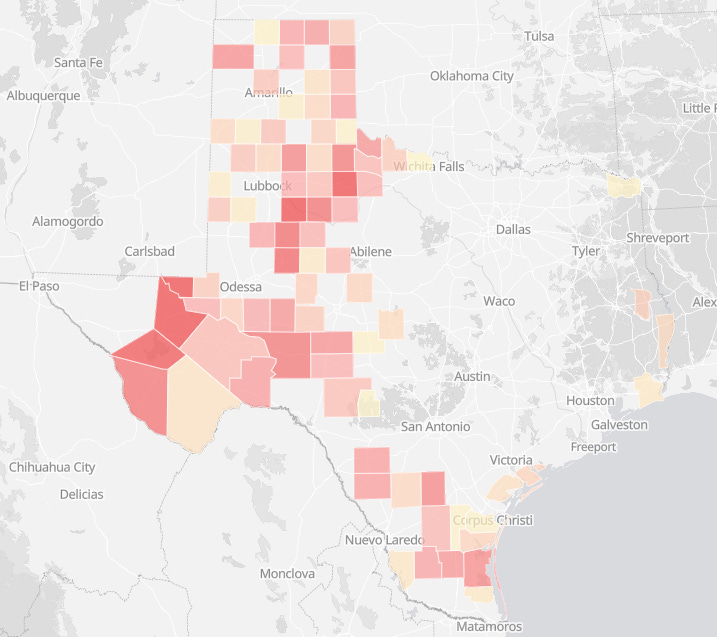
See the map: Texas Shrinking Counties
The national picture: Texas vs. everyone
Nationally, the Census data shows a Sun Belt surge and a coastal decline:
Biggest metro gains (2024-2025):
Houston: +126,720
Dallas-Fort Worth: +123,557
Atlanta: +61,953
Phoenix: +59,065
Charlotte: +54,122
Austin: +53,796
Metros that shrank:
Los Angeles: -62,454 — the single largest metro loss in America
Miami: -8,909
San Diego: -5,294
Memphis: -4,217
Four of the top 6 gainers are in Texas. The state isn’t just growing — it’s the primary destination for domestic migration in the United States. Houston and DFW together added more people in one year (250,277) than the entire state of Vermont’s population.
Explore the maps
Texas Counties — Population Growth 2020-2025 — all 254 counties, green = growing, red = shrinking
DFW Counties — Growth by County — Kaufman +42%, Dallas +1.9%
Houston Metro Growth — Harris +311K, Montgomery +25%
Austin Metro Growth — Hays +25%, Williamson +22%
San Antonio Metro Growth — Comal +28%
Texas Shrinking Counties (84 of 254) — the rural decline
Top 20 Fastest Growing Counties — Kaufman, Liberty, Rockwall lead
Data source: U.S. Census Bureau, Vintage 2025 Population Estimates (released March 26, 2026). County-level estimates based on births, deaths, and migration. All maps are interactive on TheMap.io.
Built with TheMap — making public data actually public.
https://www.census.gov/newsroom/press-releases/2026/2025-popest-metro-micro-counties.html#table-9